

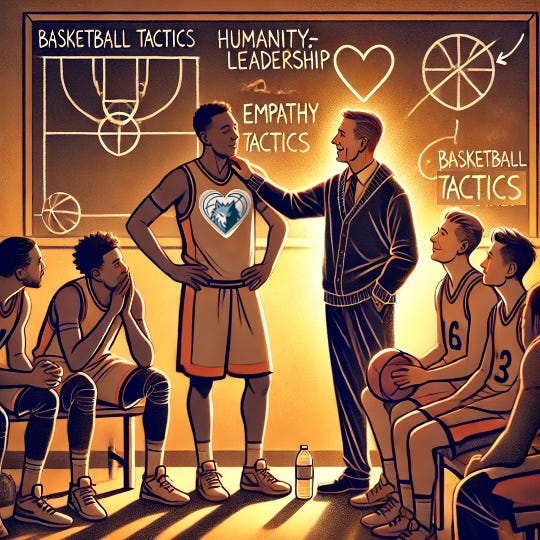
I came across a story this week that perfectly illustrates a powerful truth about leadership: sometimes the most “results-driven” thing you can do is lead with heart.
Last Friday night, Minnesota Timberwolves coach Chris Finch did something that, on the surface, went against conventional wisdom. The team had lost two straight games, was sliding in the playoff race, and needed to win. But instead of focusing purely on X’s and O’s, Finch focused on something bigger.
Just before the team meeting, he told his players that Joe Ingles — who had barely seen the floor all season — would be starting that night. Not because of strategy, but because Joe’s family was in town, including his 8-year-old son Jacob, who has autism. For the first time ever, Jacob had been able to sit through an entire NBA game earlier that week. But in that game, Joe didn’t play. Finch wanted to make sure that Jacob got to see his dad on the court before heading home.
This wasn’t a gimmick. It wasn’t a distraction. It was a reminder that leadership isn’t about treating people like pieces on a chessboard. It’s about seeing people — really seeing them — and knowing when to step beyond logic and into empathy.
What happened next? The Timberwolves didn’t tighten up or crumble. They won by 41 points. The energy shifted. The team rallied — not around a statistic, but around humanity.
There’s a deep leadership lesson here:
When leaders show they care about people beyond their output, they unlock something more powerful than any metric: trust, loyalty, and shared purpose.
Too often, leaders are forced into a false choice: do the human thing or do the “smart” thing. But humanity and high performance aren’t at odds — they reinforce each other. By putting humanity first, leaders can spark the energy, motivation, and connection that lead to better results.
Chris Finch risked criticism in a high-stakes moment. But what he gained was a team that played freer, with joy and heart — and that’s what winning teams do.
Here are a few sparks for humanity-centric leadership:
- Lead with context, not just tactics. Finch didn’t just start Joe; he explained the why to the team. That clarity and intention made everyone rally behind the decision.
- See your people as more than their role. Joe Ingles wasn’t just a reserve player. He’s a father, a husband, and a person carrying weight most of us don’t see. Every team is full of these unseen stories.
- Model that purpose matters. Finch reminded his team — and all of us — that moments of empathy and humanity aren’t distractions; they are fuel for performance.
Sometimes, leadership comes down to doing the human thing. And when you do, don’t be surprised when extraordinary results follow.